reading-notes
My reading notes journal for Code Fellows
Read Class 26: Intro to Django
How Django Works Behind the Scenes
-
Django is a Python-based web framework used by millions of developers and billions of consumers through popular apps like Instagram. It is open source, meaning the code is available for free on GitHub and can be downloaded onto any developer’s computer and used alongside the official documentation. However, I find that even professional Django developers have little insight into “how” Django is actually run, both technically and legally/financially, so this post is my attempt to provide a concise overview of it all.
-
Django was originally developed at the Lawrence Journal-World newspaper by Adrian Holovaty, Simon Willison, and Jacob Kaplan-Moss. The code was open-sourced in 2005 and developers immediately started making contributions to the codebase. Fourteen years later, Django remains under active development, with new major releases every nine months, minor security releases almost monthly, an official issue tracker, and robust discussion on the django-developers Google group.
Cited from: https://www.djangoproject.com/start/
How Django Works Behind the Scenes
-
In a traditional data-driven website, a web application waits for HTTP requests from the web browser (or other client). When a request is received the application works out what is needed based on the URL and possibly information in POST data or GET data. Depending on what is required it may then read or write information from a database or perform other tasks required to satisfy the request. The application will then return a response to the web browser, often dynamically creating an HTML page for the browser to display by inserting the retrieved data into placeholders in an HTML template.
-
Django web applications typically group the code that handles each of these steps into separate files:
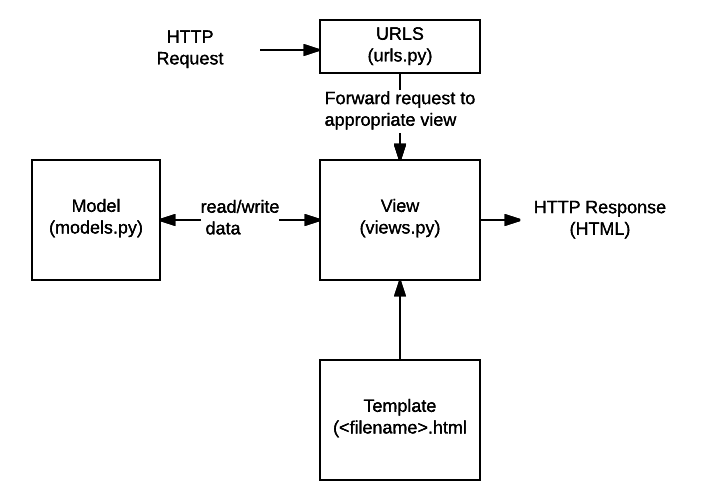
URLs: While it is possible to process requests from every single URL via a single function, it is much more maintainable to write a separate view function to handle each resource. A URL mapper is used to redirect HTTP requests to the appropriate view based on the request URL. The URL mapper can also match particular patterns of strings or digits that appear in a URL and pass these to a view function as data. View: A view is a request handler function, which receives HTTP requests and returns HTTP responses. Views access the data needed to satisfy requests via models, and delegate the formatting of the response to templates. Models: Models are Python objects that define the structure of an application’s data, and provide mechanisms to manage (add, modify, delete) and query records in the database. Templates: A template is a text file defining the structure or layout of a file (such as an HTML page), with placeholders used to represent actual content. A view can dynamically create an HTML page using an HTML template, populating it with data from a model. A template can be used to define the structure of any type of file; it doesn’t have to be HTML!
Cited from: https://developer.mozilla.org/en-US/docs/Learn/Server-side/Django/Introduction
Things I want to know more about
- There is a lot I would still like to learn about Django I’m still confused on how it works in general, but it’s only my first day being introduced to I just need sometime playing around with it. I understand that It is for web development I thought python was for backend work only, but I guess that’s where the confusion comes in it can do frontend work as well, so I’d like to better understand how that works
References
- https://www.djangoproject.com/start/
- https://docs.djangoproject.com/en/4.1/intro/tutorial01/
- https://docs.djangoproject.com/en/4.1/intro/tutorial02/
- https://wsvincent.com/how-django-works-behind-the-scenes/
- https://developer.mozilla.org/en-US/docs/Learn/Server-side/Django/Introduction